

Real Food, Real Life: A Beginner’s Guide to Eating Clean Without Going Crazy
Lorem Ipsum is simply dummy text of the printing.
You ate. You know you ate. The calories were there. And yet, an hour later, there’s that pull again — the hand moving toward the cabinet, the eye scanning the fridge, the familiar background noise of want.
Most people call that a lack of discipline. The nutrition industry calls it a marketing opportunity. The research calls it something more specific: the protein leverage effect — and once you understand it, a lot of your eating behavior starts making more sense.
Your body doesn’t simply eat for volume or even calories — it eats to hit nutritional targets. Protein is one of the most tightly regulated of these targets. According to the Protein Leverage Hypothesis, first proposed by researchers David Raubenheimer and Stephen Simpson at Oxford in 2005, the body will continue to generate hunger signals until it reaches its protein threshold — even if it’s already consumed plenty of fat and carbohydrates to meet its energy needs.
In other words: your body will keep pushing you to eat more food if the food you’re eating isn’t protein-dense enough — because it’s still searching.
This isn’t a character flaw. It’s a biological directive.
Before going further, it’s worth drawing a line that the food industry rarely draws clearly: there’s a meaningful difference between whole food protein and manufactured protein.
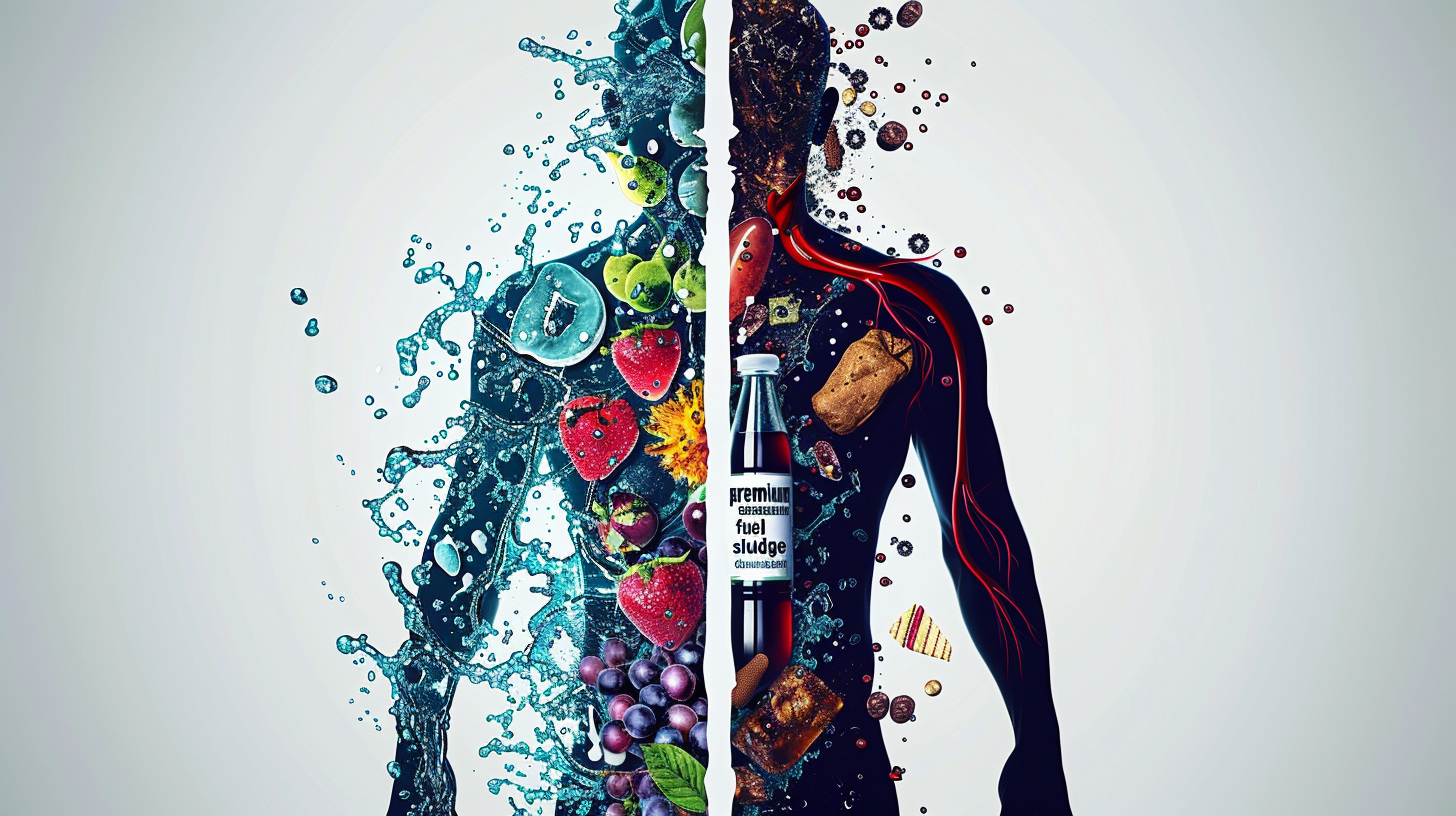
Whole food protein comes packaged the way nature built it — inside eggs, meat, poultry, fish, legumes, dairy, nuts, and seeds. When you eat a chicken breast or a bowl of lentils, you’re not just getting protein. You’re getting the vitamins, minerals, enzymes, and co-factors that come with it — the full nutritional context your body recognizes and knows how to use. The protein arrives with its support system intact.
Manufactured protein — protein powders, bars, shakes, and fortified snack products — is extracted, isolated, and reassembled into a delivery format. Some of these products are well-made and serve a real purpose, particularly for athletes with high output needs or people in specific recovery situations. But as a primary protein strategy, they often lack the broader nutritional matrix of whole foods, and they can create a dependency on convenience formats rather than building real food literacy.
The clarity point isn’t that one is good and the other is evil — it’s that they’re different tools serving different purposes. A protein bar on a long travel day is a reasonable choice. Replacing most of your whole food protein with engineered alternatives is a different conversation entirely.
At Diet Discipline, when we talk about building protein into your meals, we’re talking about food. Real, recognizable sources your body has been processing for as long as humans have existed.
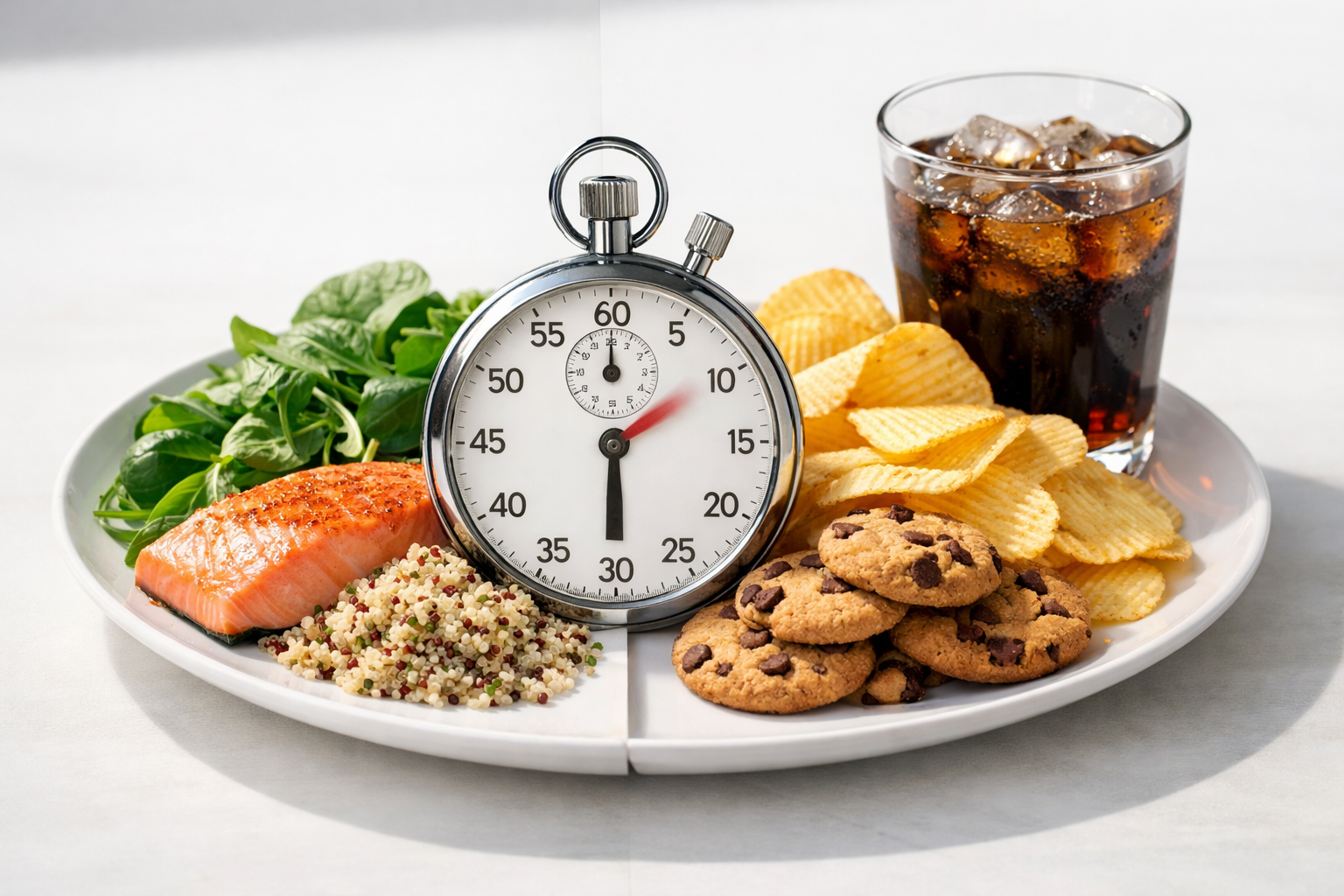
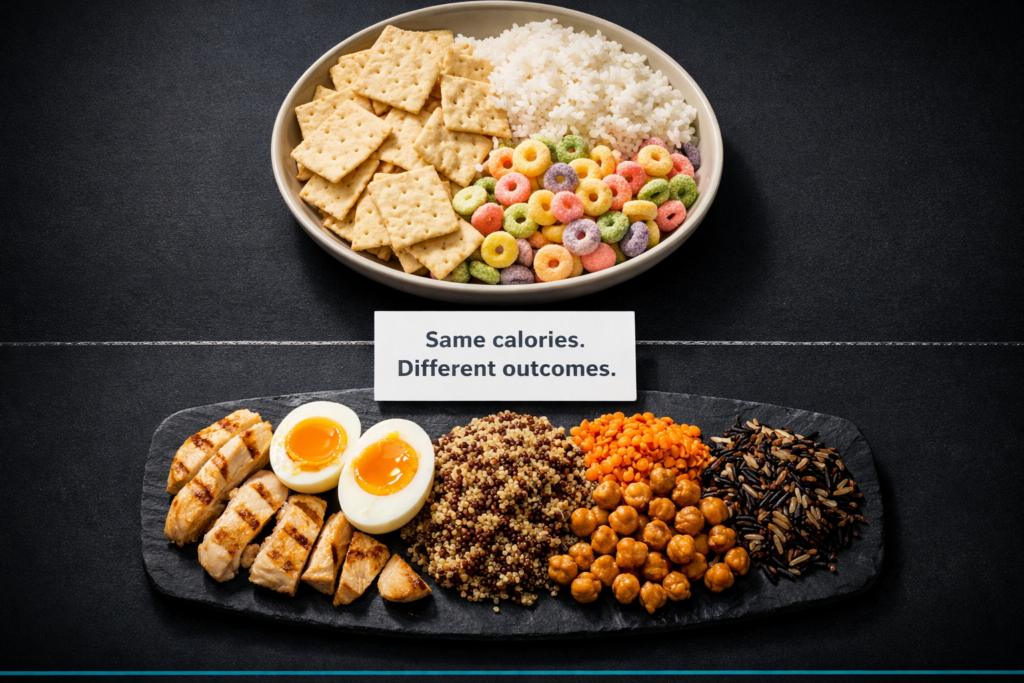
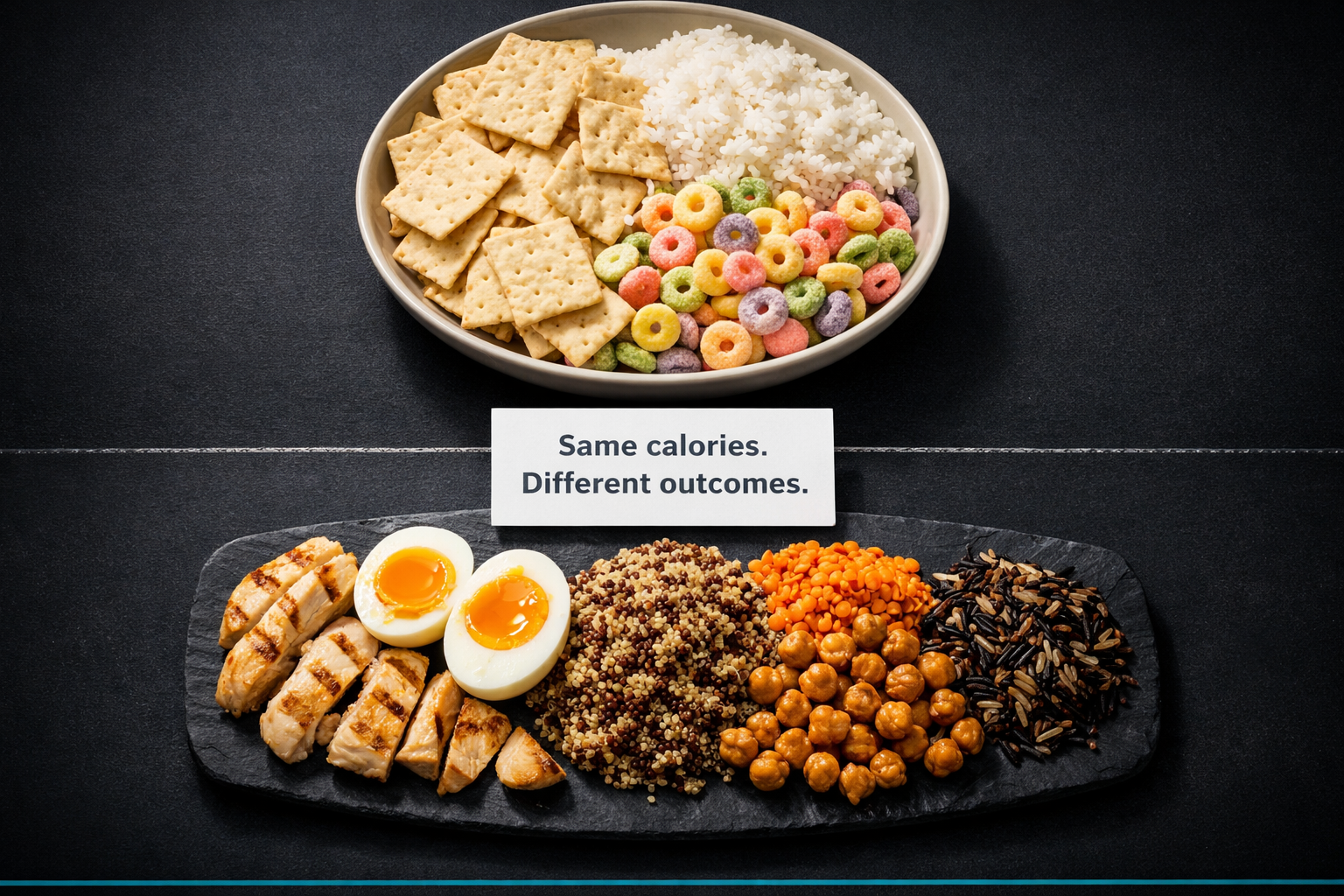
Here’s where food clarity becomes critical. The typical modern diet is heavily skewed toward processed carbohydrates and fats — foods that are calorie-dense but protein-dilute. Think crackers, cereals, sweetened yogurts, flavored chips, most fast food combinations. These foods are engineered to be palatable and filling in the moment, but they often deliver a low protein-to-calorie ratio.
When you eat a high-carb, low-protein meal, your body registers the energy but not the protein target. So hunger returns — sometimes quickly, sometimes within a couple of hours. You eat again. More energy comes in. Still not enough protein. The cycle continues.
The result isn’t overeating from greed or lack of focus. It’s your body doing exactly what it was built to do: keep seeking what it needs.
A 2011 study published in PLOS ONE tested this directly. Participants who received a diet with only 10–15% protein consumed significantly more total calories than those eating a diet with 25% protein — even though all groups had unrestricted access to food. The higher-protein group reached satiety faster and stopped eating sooner. Not because of rules. Because their bodies were satisfied.
This is where discipline-building and food clarity intersect. Most people interpret recurring hunger as weakness — and that interpretation becomes its own problem. You ate “enough,” you feel hungry again, you assume you have no self-control, you feel shame, and shame rarely produces better decisions.
But if recurring hunger is often a nutrient signal rather than a willpower failure, the intervention changes completely.
You don’t need more rules. You need better protein targets.
The general research consensus points to somewhere between 0.7 and 1.0 grams of protein per pound of body weight for active, health-focused individuals — though this varies based on age, activity, and goals. The more actionable takeaway: most people are eating well under this range without realizing it, not because they’re eating too much, but because their meals are quietly protein-thin.
Before overhauling anything, start with awareness — the first move in food clarity.
For three days, don’t change what you eat. Just look at your meals and ask: What is the primary protein source in this meal, and how substantial is it?
Not obsessive calorie tracking. Just a question. A lens.
You’ll likely notice patterns fast. The breakfast that’s mostly toast and juice. The lunch that’s mostly bread and a thin layer of something. The dinner that’s mostly pasta with a small side of protein. When you see those patterns, you’re not seeing failure — you’re seeing information.
From there, the upgrade is often simple: add a meaningful whole food protein source to the meals that don’t have one. Eggs or cottage cheese at breakfast. A full portion of chicken, fish, or legumes at lunch. Plain Greek yogurt instead of sweetened alternatives. A handful of mixed nuts alongside a light meal. These aren’t restrictions — they’re additions that work with your body’s existing targeting system rather than against it. And because they come from whole foods, you’re not just hitting a protein number — you’re feeding the whole picture.
This is not a pitch for any particular diet. Whole food protein looks different across food cultures, budgets, and lifestyles — and it should. Animal protein, plant protein, and combination approaches can all support adequate intake when they’re built from real, recognizable ingredients.
This is also not a suggestion that calories don’t matter or that protein is a magic fix. Nutrition is layered, and individual variation is real.
What this is: a reframe. Hunger is information. Recurring hunger after eating often points to something missing — and that missing thing, more often than people realize, is protein. Knowing that doesn’t just change what you eat. It changes how you interpret yourself when you reach for more food.
That shift in interpretation is where discipline actually starts.
“Your body will keep pushing you to eat more if the food you’re eating isn’t protein-dense enough — because it’s still searching. That’s not a willpower problem. That’s biology doing its job.”
Get exclusive deals by signing up to our Newsletter.
Lorem Ipsum is simply dummy text of the printing.

Lorem Ipsum is simply dummy text of the printing.

Lorem Ipsum is simply dummy text of the printing.
“Your body will keep pushing you to eat more if the food you’re eating isn’t protein-dense enough — because it’s still searching. That’s not a willpower problem. That’s biology doing its job.”